Pollinator garden plans › A Balcony Pollinator Garden in Six Pots
A Balcony Pollinator Garden in Six Pots
- Full sun to half shade
- Temperate, any hardiness zone above 5
- about 3 m²
A balcony is not a compromised garden; it is a different one. It has advantages a border does not - warmth stored in brick, shelter from wind on two sides, and no slugs to speak of - and one serious disadvantage, which is that a pot dries out in hours and a dry plant produces no nectar. This plan uses six containers and about three square metres of floor space and is designed around a single constraint: keeping water in the pots.
The plan
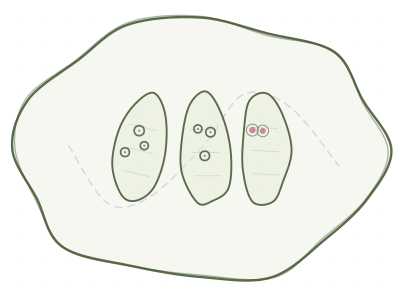
Arrange the pots in three groups rather than a single row, because a row of pots is mostly soil surface and each pot shades nothing. Clustering them means the canopy closes over the gaps, the soil stays cooler, and a butterfly moving through the group finds several flowers without crossing open floor. Put the buddleia in the largest pot at the back against the wall; it will reach about 1.2 m in a dwarf form and needs the wall's stored heat to flower well. Put the host plants - dill, borage, nasturtium - at the front where you will notice caterpillars before you water over them. If the balcony catches wind, put a pot of lavender at the exposed end as a windbreak even if the flowers are not the main event there.
Planting order
Work through these in sequence. The order matters more than the exact spacing — several of the steps are about removing fertility or opening the ground before anything is planted.
- Measure the balcony floor, not the railing. Pots on a railing bracket dry out twice as fast as pots on the ground and are much harder to water properly.
- Use the largest pots you can physically get up the stairs. A 30 litre pot holds moisture through a hot afternoon; a 5 litre pot does not, and the plants will be stressed exactly when the butterflies need them.
- Group pots into three clusters: a nectar cluster, a host cluster, and a windbreak cluster at the exposed end.
- Put the tallest plant - buddleia - at the back and against a wall. It will flower best with its roots shaded and its head in the sun, so underplant it with alyssum.
- Sow dill and borage in succession, one pot every three weeks from April, because black swallowtail caterpillars will strip a pot in two days.
- Keep a saucer of wet sand on the floor between the pots. Even a third-floor balcony will draw puddling males.
Plant list
| Plant | Botanical name | Role |
|---|---|---|
| Lavender | Lavandula angustifolia | Nectar · adult food |
| Buddleia (dwarf) | Buddleja davidii 'Buzz' | Nectar · adult food |
| Marjoram | Origanum vulgare | Nectar · adult food |
| Borage | Borago officinalis | Host · caterpillar food |
| Nasturtium | Tropaeolum majus | Host · caterpillar food |
| Dill | Anethum graveolens | Host · caterpillar food |
| Sedum | Hylotelephium spectabile | Nectar · adult food |
| Sweet alyssum | Lobularia maritima | Nectar · adult food |
Plants and why they are here
Lavender is the workhorse: it flowers from June to August, it is drought-tolerant, and it survives neglect better than any other nectar plant in a pot. Marjoram is the second - it flowers for months, it is small enough for a windowsill, and it is a magnet for small blues and skippers. Dwarf buddleia gives you the August peak. Sedum carries you into October when everything else has finished, and its flat flower heads are landing platforms that even exhausted migrants can use. Borage and nasturtium are hosts, and both are worth growing for their own sake: borage is one of the few flowers that refills with nectar fast enough to be worth visiting twice in a day.
Aftercare
Water in the evening, not the morning, and water until it runs out of the bottom - a half-watered pot is worse than an unwatered one because it draws roots up into the dry zone. In July and August a 30 litre pot in full sun may need watering twice a day. Feed with a dilute liquid feed every fortnight until August, then stop, because you want flowers and not leaves. Top-dress with compost in spring rather than repotting, unless the roots are circling the drainage hole. In winter, move terracotta pots against the wall and raise them on feet: a pot that sits in water through a freeze will crack.