Butterfly dossiers › Whites and yellows › Small White (Cabbage White)
Small White (Cabbage White)
Pieris rapae · Whites and yellows
The small white is the most familiar butterfly in the world and the most disliked one. Its caterpillar is the green worm on the broccoli, and every gardener has met it. That is the price of success: the small white has followed human agriculture across two continents because we grow its host plants in enormous monocultures. Set the pest problem aside and it is a remarkable species - one of the fastest butterflies to colonise a new continent and still spreading.
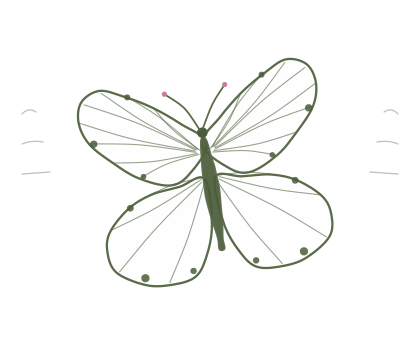
- 4.5-5.5 cm wingspan
- Whites and yellows
- Host: Cabbage, broccoli, kale, radish, nasturtium, wild mustard and other Brassicaceae
Identification
Pure white wings with a black tip to the forewing. The spring brood has an almost unmarked white upper surface; the summer brood has larger black tips. The female has two black spots on the forewing, the male one - and in some males the spot is faint, which makes them look almost entirely white. The underside of the hindwing is a pale lemon yellow, which is the surest mark at rest. Compare with the large white, which is noticeably bigger, has a black band extending down the trailing edge of the forewing, and whose caterpillar is yellow-and-black speckled rather than plain green.
Habitat and where to look
Everywhere. Gardens, farmland, city centres, mountain meadows, coastal cliffs. The small white is one of the few insects found in all of them. Adults fly low and continuously, rarely pausing, and they visit a very wide range of small flowers. In cold climates they overwinter as pupae attached to walls, fences and dead plant stems, which is why they are often the very first butterfly seen in a city in spring.
Life cycle
Eggs are laid singly, on the underside of brassica leaves, and each one is a pale green bullet standing on end. The caterpillar is exactly the green of a cabbage midrib with a faint yellow line along the back, and it works along the leaf from the edge, leaving a window of transparent epidermis. It is heavily parasitised by a small wasp, and a cabbage white caterpillar carrying a parasitoid larva looks normal until it pupates, at which point the wasp emerges instead. The chrysalis is attached by a silk girdle to the food plant, a fence or a wall, and it is the overwintering stage in cool climates.
How to attract it
If you want them, plant alyssum and lavender, and let a few radishes or nasturtiums flower. If you want them in the garden but not in the vegetable bed, put nasturtium and wild mustard well away from the brassicas as a trap crop, and cover the cabbages with fine mesh between May and August rather than spraying. Netting is the only reliable control - a small white can slip through a gap the size of a fingernail. In a meadow planting, the small white is a useful early-season nectar visitor and its abundance feeds a whole food web of birds and parasitic wasps.