Butterfly dossiers › Brush-footed › Painted Lady
Painted Lady
Vanessa cardui · Brush-footed
The painted lady is the most widespread butterfly on earth, found on every continent except Antarctica. It cannot survive cold winters, so it does something more interesting than hibernate: it keeps moving. In a single spring, successive generations travel from North Africa across the Mediterranean and deep into northern Europe, and in big years hundreds of millions cross at once. Any garden, at any latitude, can host one.
- 4.8-6.5 cm wingspan
- Brush-footed
- Host: Thistles, mallows, hollyhock, common nettle, lupin, borage
Identification
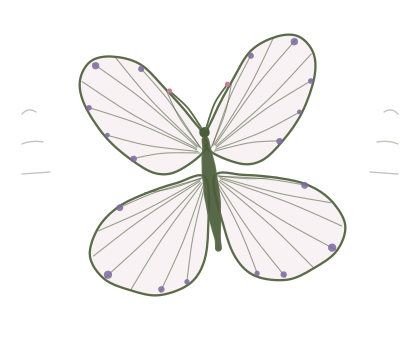
Mottled orange, brown and black on the upper surface, with a white bar in the middle of the forewing and a row of four small eyespots near the tip of the hindwing. The underside is a complex marbled pattern of grey, brown and pink with five small eyespots on the hindwing. The similar American lady has two large eyespots on the hindwing underside rather than four to five small ones, and a white dot inside the forewing's orange patch.
Habitat and where to look
Almost anywhere with flowers and sun: gardens, brownfield sites, coastal dunes, alpine meadows up to about 3,000 m, deserts in wet years. The species has no fixed habitat because the migration has no fixed route. In outbreak years, larvae can be so abundant that they strip entire thistle fields and the adults can be seen flying north in a steady stream for days.
Life cycle
The female lays single eggs on the upper surface of host leaves, favouring thistles and mallows but happy with a wide range of plants. The caterpillar is spiny, variable in colour from yellow to near-black, and lives inside a silk tent it spins by pulling leaf edges together. Unlike the monarch it is not poisonous and relies on spines and concealment. The pupa hangs from a stem or a wall, grey-brown with metallic gold flecks, and the adult emerges in as little as two weeks in summer. In warm regions there can be five or six overlapping generations in a year, which is how the front of the migration keeps moving north.
How to attract it
This is the easiest butterfly to attract, and the most forgiving. Plant a large block of cosmos or asters and it will come. Leave a patch of thistles if you can, or grow hollyhock and borage, both of which are hosts and both of which are attractive garden plants. Because painted ladies are exhausted migrants, they need nectar in volume rather than rare plants - a dense block of one flower beats a collector's border. They are also the classic species for a butterfly feeder or overripe fruit tray, and they will happily take fruit juice from a saucer.